Nobel Laureate Philippe Aghion launches a new IPI and BSC series: AI will transform work organisation and accelerate innovation
Philippe Aghion, winner of the 2025 Nobel Prize in Economics and the world’s leading authority on the “Schumpeterian” theory of creative destruction, outlined at the opening of the “Barcelona AI: Innovation, Productivity, and Welfare” series the key features that define artificial intelligence (AI) as a new industrial revolution.
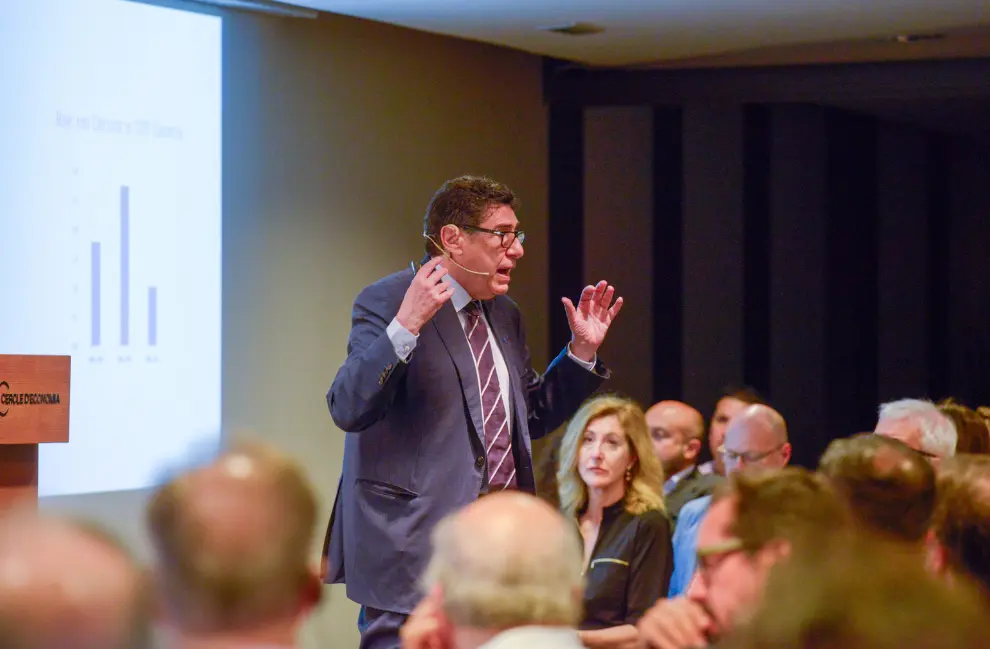
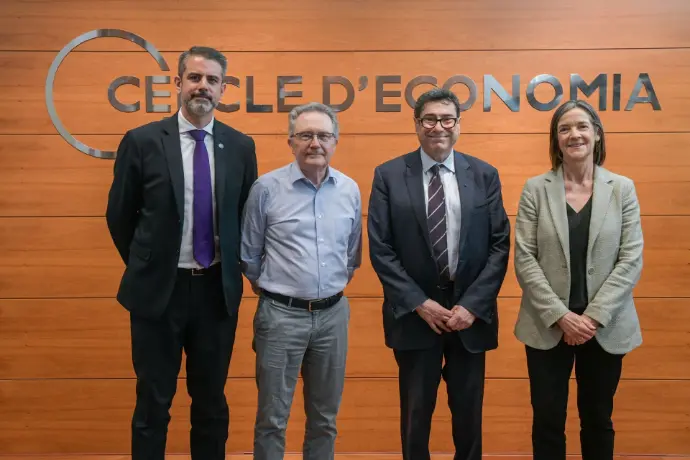
The Initiative for Productivity and Innovation (IPI) —the think tank launched by the Cercle d’Economia—and the Barcelona Supercomputing Center (BSC) have joined forces to launch this series, which aims to put the Catalan capital on the global map of thought regarding the economic and social effects of AI.
In a conversation with Xavier Vives, Chair of the IPI Advisory Board, Aghion argued that in the age of AI, basic skills (reading comprehension, the ability to express ideas in writing, and proficiency in mathematics) are once again more important than ever. He maintained that a high-quality education system will become a competitive advantage, as will a social protection model similar to Denmark’s—one that combines flexibility for businesses with strong protection for workers during periods of transition.
Barcelona’s Opportunity
Aghion, speaking with both passion and rationality, acknowledged Europe’s decline relative to the United States and China. He called for European capital to be invested in technology developed in Europe rather than flowing through investment funds to American tech giants. He advocated for local supercomputing capabilities, a European cloud infrastructure (currently dominated by Amazon, Microsoft, and Google) and stronger investment in European science and talent. In this context, he highlighted Barcelona’s opportunity to play a significant role in the new revolution in semiconductor chips, open-source technologies, and the convergence of data and science. The BSC is a global leader in supercomputing and is working to design the European chip of the future.
The economist, who helped draft the Draghi Report and is a strong advocate of open competition as a driver of innovation, acknowledged that new technologies will disrupt existing business models and eliminate some jobs. However, they will also create new, more productive forms of employment. “The role of the government,” he argued, “is more important than ever in providing training and social protection for workers who need to reskill.”
Redesigning Work
AI, he emphasised, will require a redesign of the very organisation of work, placing greater emphasis on professional skills such as versatility and flexibility. He praised Swiss culture, where it is considered valuable for university-educated individuals to possess practical manual skills as well.
According to the Nobel laureate, “it is possible to tame the AI horse,” and the effort is worthwhile. Automating both production and idea generation could boost economic growth more than any previous technology, increasing productivity by as much as 0.7–1 percentage point per year over a decade, with lasting effects beyond that period. Europe still has time to compete successfully if it can overcome a culture of excessive regulation and fear of failure in business. To innovate and succeed, you have to try many times. Without failure, there is no success.