
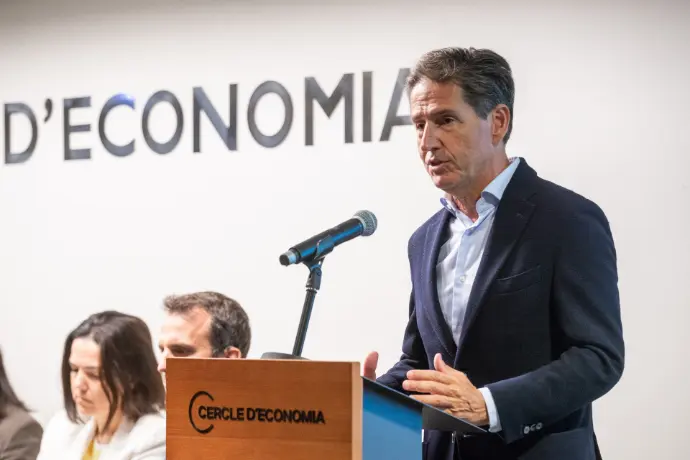
Interview with Enrique Tombas, Chairman of SpainCap, the association that groups Venture Capital and Private Equity entities in Spain
“We have to invest our talent and innovative capacity into global companies”
Europeans save more than in any other major developed economy, but a substantial proportion of that capital doesn’t go towards funding innovation and business growth. For Enrique Tombas, Chairman of SpainCap and founding partner of Suma Capital, the challenge is not to generate more ideas, but to transform scientific, technological and entrepreneurial talent into global companies capable of competing with the United States and China. In this interview for the IPI, he discusses how to channel savings into the productive economy, what reforms Spain needs to boost investment in innovation, and why Barcelona can play a leading role in building Europe’s technology champions.
Europe has the highest savings rate in the developed world, but little of that capital is channelled into innovation. Why is there this disconnection, and what reforms would help channel private savings into Spanish funds and high-growth businesses?
Europe’s problem is not a lack of savings, but the difficulty of channelling them into productive investment. We have a huge capacity for saving, but a very significant proportion remains in deposits and low-risk products, or is channelled into markets and companies outside Europe. The financing needs of our businesses are not, therefore, tied to people’s savings.
To put this right, we need to take action on three fronts. Firstly, by developing investment vehicles that enable savers to participate, in line with their risk profiles and time horizons, in the creation of long-term value. Secondly, by helping pension funds and insurers to invest in private equity, with regulatory and governance frameworks that recognise the long-term nature of these assets. And thirdly, by strengthening tax incentives and regulatory stability in order to encourage investment in funds that finance Spanish and European companies.
"Channelling capital into innovation is strategic for our competitiveness and our economic autonomy"
In short, Europe needs to link savings more effectively to the real economy. Channelling capital into innovation isn’t just about finance: it’s a strategic decision for our competitiveness and our economic independence.

The major global tech companies are American, while China is pushing ahead with electric vehicles, artificial intelligence and robotics. Are we lacking ideas, or do we lack the capital to turn those ideas into businesses capable of competing on a global scale?
Europe has talent, world-class research centres and an extraordinary capacity for generating knowledge and innovation. Spain also has highly competitive entrepreneurs and technology teams. I don’t think our main problem is a lack of ideas; the challenge is to turn them into global businesses.
To do this, we need more capital, particularly during the growth stages, when a company has already demonstrated that its technology works and needs to invest heavily to gain market share, develop products, recruit talent and compete internationally. In Europe, we see market fragmentation, shallower capital markets and limited access to large funding rounds compared with the United States.
We must also accept that developing global leaders takes time, investment and a certain tolerance for risk. Not all investments will be successful, but without taking that risk, it’s impossible to build companies capable of leading strategic sectors.
The priority must be to bridge the gap between innovation and industrialisation, and between the launch of a start-up and its establishment as an international company. Europe should not be resigned to developing excellent technologies only for other countries to turn them into lucrative businesses.
"The main bottleneck lies in the growth phases: there are competitive start-ups, but not enough large funding rounds to enable them to expand internationally"
Sweden, Estonia, Israel, Singapore and the United Kingdom have established frameworks that encourage reinvestment and scaling up. What examples of international practice are relevant to Spain, and which incentives would work best in our context?
The first thing to learn is that innovation ecosystems are not built solely on public funding: they require continuity, collaboration between the public and private sectors, talent and capital available at every stage of business development.
These countries can teach us the importance of encouraging long-term investment, facilitating the reinvestment of capital gains in new projects, and designing incentives to support businesses from their early stages right through to their international expansion. It is also essential to have predictable regulations and straightforward administrative procedures.
In Spain, this would particularly strengthen incentives for institutional investors and private savers to invest in private equity funds. It would also encourage entrepreneurs and investors to reinvest profits in new businesses, and promote collaboration between universities, technology centres, corporations and investment funds.
It is not a question of copying models from other countries, but of adapting best practice to our economic structure. Spain has a significant industrial base, a network of SMEs with potential for growth, and sectors in which we can develop competitive advantages. We need stable policies that will enable us to capitalise on these strengths for many years to come, not one-off measures that change with every political cycle.

Barcelona has established itself as a European hub for biotechnology, computing and deep tech. What role can the city play in the European and global context, and what does it need to do to attract more capital during periods of growth? Is it necessary to specialise further in a particular field?
Barcelona is well placed to become one of Europe’s major centres of innovation. It is home to universities, research centres, leading hospitals, international talent and an entrepreneurial community that has succeeded in attracting projects and creating companies with high added value.
The city’s potential lies in tying these scientific capabilities to a greater capacity for business and industrial development. In biotechnology, digital health, computing and deep tech, there are opportunities to develop companies with our own technology and an international focus. Furthermore, Barcelona can act as a gateway to European markets and as a hub linking research, industry and capital.
To take the next step, it needs, above all, more funding for growth, greater access to specialist talent, and closer collaboration between technology firms and large corporations. It is also important to facilitate access to research infrastructure, experimental facilities and appropriate regulatory frameworks in order to develop and commercialise new technologies.
"Barcelona has what it takes to become one of Europe’s major hubs for biotechnology, healthcare, computing and deep tech, so long as there is further funding for growth"
Regarding specialisation, I believe we should focus on those areas where we already have distinctive strengths, without sacrificing diversification. Biotechnology, healthcare, computing and advanced industrial technologies offer clear opportunities. However, specialisation will only generate value if it is accompanied by a global ambition and funding mechanisms capable of sustaining the growth of businesses.
Spain and Europe produce good start-ups but few large companies. What is missing between Series A and Series C to enable more technology companies to scale up?
There is a funding gap and a lack of business skills. In the early stages, start-ups can grow with small teams, relatively limited funding and promising technology. But when it comes to scaling up, the requirements change radically: they need greater financial resources, experienced management teams, international commercial structures and the capacity to implement far more complex growth plans.
In Europe, many companies struggle to raise large amounts of funding without turning to international investors or relocating part of their operations to other markets. There is also a degree of fragmentation which makes it hard for businesses to grow uniformly across the European market.
Private equity can play a key role at this stage, providing funding and strategic support to help professionalise the organisation, expand sales internationally, carry out acquisitions and improve management processes. It is not simply a matter of investing more money, but of helping to transform a promising business into an organisation capable of competing on a global scale.
This calls for investment funds with greater financing capacity, attracting more institutional investors and enabling companies to grow without being forced to look outside Europe for all the resources they need. The success of an ecosystem should not be measured solely by the number of start-ups it creates, but also by how many of them it manages to turn into international leaders.
More than 80% of European corporate venture investment ends up in the US. Where is the relationship between corporations and the local ecosystem going wrong, and how can this be rectified?
The figures highlight an important point: European corporations recognise the value of innovation, but can’t always find the necessary structures, incentives or agility in their own markets to invest in and collaborate with tech businesses.
There is often a cultural and operational gap between a start-up – which needs to experiment, make quick decisions and take risks – and a large corporation, whose procurement, regulatory compliance and decision-making processes can be much slower. Plus, the United States has deeper capital markets and a higher concentration of large technology companies.
The solution lies in making partnerships between corporations and start-ups a genuine part of business strategy, rather than an isolated innovation initiative. This means bigger companies must set clear objectives, establish autonomous teams, implement more streamlined recruitment procedures and put mechanisms for testing and adopting new technologies in place.
Corporate venture capital funds and co-investment vehicles with independent managers can also play an important role, as they bring financial expertise, access to the entrepreneurial ecosystem and professional investment criteria.
If we want to retain more innovation in Europe, we must ensure that our corporations are not only investors, but also customers, industrial partners and platforms for growth for European tech businesses.
In 2025, private equity invested 7.015 billion in Spain, but more than half of this came from international fund managers. Is it a sign of attractiveness or of dependence?
It is, first and foremost, a sign of confidence in the Spanish economy and in the quality of our companies. The fact that international investors are channelling resources into Spain shows that they see attractive opportunities, strong management teams and companies with growth potential. This engagement is positive and we must continue to encourage it.
That said, it also highlights the need to build up a larger domestic capital base. If we want to build a robust ecosystem, we cannot rely too heavily on investment decisions taken outside our borders. It is vital that more of the savings generated in Spain are channelled into financing the growth of our businesses.
The aim should not be to replace international capital with domestic capital, but to ensure they complement each other. International investors bring resources, expertise and global connections; domestic investors can help ensure the continuity of funding and strengthen the links between savings, the business sector and the Spanish economy.
Spain has shown that it can attract investment. The next step is to ensure it can also systematically channel its own savings into private capital, innovation and business growth.
Spanish pension funds and insurance companies invest very little in domestic funds. What would be a reasonable percentage of their portfolios, and what regulatory or governance changes would make it possible to achieve this?
I believe we should approach this issue from the perspective of diversification and long-term profitability. While private equity can help diversify institutional portfolios and provide exposure to the growth of unlisted companies, these are illiquid investments with risks that must be properly weighed up.
I would not set a mandatory, uniform percentage for all organisations. The amounts they allocate should be based on their commitments, time horizon, liquidity needs, risk tolerance and ability to analyse and manage this type of investment. We could start by suggesting that institutional investors with sufficiently long-term horizons consider gradual putting 3-5% of their funding into private equity assets, provided these align with their investment policies and prudential requirements.
"We need to make it easier for pension funds and insurance companies to invest in private equity"
To move forward, we need predictable regulatory frameworks, a proportionate application of prudential requirements, and governance that allows investments to be assessed using long-term criteria that do not automatically penalise illiquidity. It is also important for decision-making bodies to have specialist knowledge and for investment vehicles that facilitate access to these assets to be developed, with appropriate diversification and transparency.
At SpainCap, we advocate for the need to better link institutional savings with the productive economy. If we want more innovative and competitive businesses, we must ensure that a reasonable proportion of Spanish savings is channelled into financing them.
Catalonia has a large community of medium-sized family-run industrial businesses whose growth is limited. What does private equity offer apart from capital, and what evidence is there that it improves productivity and competitiveness?
Private equity can be a particularly valuable partner for family-owned businesses that have built a solid business but need to take a leap forward in terms of scale, professionalisation or internationalisation.
Its contribution goes far beyond funding. Good investors help businesses to define a growth strategy, bring in talented management, improve management systems, digitise processes, invest in innovation and gain access to new markets. They can also facilitate acquisitions that enable companies to grow, expand their technological capabilities or consolidate fragmented sectors.
In family businesses, moreover, they can help to organise succession, strengthen corporate governance and ensure a clear separation between family and business decisions, while respecting the legacy and vision of the founders.
The available evidence on companies in various markets in which private equity funds have a stake shows that these investments can lead to operational improvements, growth, professionalisation and, in certain cases, increased productivity. However, results vary depending on the sector, the company, the investor’s strategy and the time horizon; it would be wrong to automatically attribute all the improvements to private capital.
In Catalonia, which has a very significant industrial base, private capital can help more medium-sized businesses to grow into larger companies, with greater export capacity, increased investment in technology and greater resilience in the face of international competition. The aim is to build stronger and more sustainable businesses, capable of creating quality jobs and competing in global markets.
If you had to sum up in one sentence what Spain needs to do to be competitive in innovation by 2030, what would you say?
Spain needs to transform its talent and capacity for innovation into global companies, by mobilising more long-term capital, professionalising management and creating a stable framework that rewards investment, growth and responsible risk-taking.
In your experience, how should management teams in start-ups and scale-ups be put together to maximise their chances of success? What balance should there be between technical and managerial roles, and what should the relationship with investors be like to ensure sound, but ambitious, progress?
A start-up usually stems from a good idea, a distinctive technology or the ability to identify a market need. However, as it grows, it needs to become a well-run business. This means management teams must evolve at the same pace as the business.
In the early stages, it is natural for the founders of the business and individuals with technical expertise to predominate, because the priority is to develop the product,
validate the technology and find a viable business model. As a company begins to scale up, it needs to bring in expertise in finance, sales, operations, people management and internationalisation. There is no ideal ratio between technical staff and managers: the right balance depends on each company’s business, maturity and challenges. The key point is that technical expertise and business execution skills should complement one another.
I also believe the founders must be willing to bring in external talent and to develop their own leadership skills. Making a company more professional does not mean losing its entrepreneurial culture, but rather equipping it with the skills it needs to grow without losing its agility or vision.
Relations with investors, meanwhile, must be based on trust, transparency and shared objectives. An investor provides capital, but also expertise, contacts, strategic discipline and support in complex decision-making. For this relationship to work, it is necessary to share relevant information, establish clear indicators, maintain an open dialogue on risks, and agree on a shared vision for growth and the use of resources.
In my experience, the best relationships between companies and investors combine ambition with rigour: ambitious targets, data-driven decisions, the ability to change course when necessary, and a shared long-term vision. The aim should not be to grow at any cost, but to build robust, profitable businesses capable of generating value sustainably.